Septic backing up? Call (803) 2-PUMP-IT  ·  Tier 3 certified in SC, certified in GA  ·  Serving the CSRA since 2009

Ground Penetrating Radar (GPR) Scanning in SC & GA

Find the septic tank, the drainfield, buried lines and old debris before the pool crew or the addition crew breaks ground. No digging, no probing rods, no guessing.

✓ Tier 3 certified in SC, certified in GA✓ Licensed, bonded & insured✓ No digging, no yard damage✓ Family run since 2009
The short answer

Ground penetrating radar (GPR) sends radio pulses into the ground and reads what bounces back, so we can find septic tanks, drainfield lines, buried pipes and old debris without digging a hole. Carolina Septic scans yards across the CSRA before pools, home additions, fences and driveways go in, so you find the problems at the planning stage instead of with an excavator.

When a scan pays for itself

The expensive surprises happen in the first hour of digging. A scan moves them to the planning stage, where they cost nothing to fix.

Putting in a pool

Pool excavation is one of the fastest ways to destroy a septic tank or drainfield, and a pool that lands on the field can mean moving the whole system. Scan first and the pool gets designed around what is really there.

Building an addition, garage or ADU

New footings over a drainfield line or tight against the tank can stop a permit cold. Find the system before the footprint gets drawn, not after.

You cannot find your septic tank

No lid showing, no records, previous owner long gone. Radar finds the tank without probing half the yard with a steel rod.

Buying a house with no septic records

Know where the tank and field sit before you close. Pair it with a septic inspection for the full picture.

Fences, decks, driveways and sheds

Post holes and loaded concrete trucks crush drainfield lines. A scan shows you where not to set a post or park a truck.

Irrigation, trenching and landscaping

Private water, power and gas lines past the meter are not marked by 811. They are yours to find, and radar is how you find them.

What radar finds, and what it does not

No scanning method sees everything. Here is the honest version, so you know what you are paying for.

What we find
  • ✓Septic tanks, concrete, plastic and fiberglass
  • ✓Distribution boxes and drainfield lines
  • ✓Private water, sewer and gas lines past the meter
  • ✓Metal and plastic pipe and conduit
  • ✓Buried debris, old slabs and forgotten foundations
  • ✓Disturbed soil from old trenches and backfill
Where it has limits
  • !Wet clay shortens its reach. Sandy soil lets radar read deeper. Saturated clay absorbs the signal. We tell you where the soil limited the read.
  • !Depth has limits. Tanks and lines usually sit within a few feet of the surface, which is where GPR works best.
  • !It shows shapes, not labels. Reading what a shape is takes experience in the ground, not just on the screen.
  • !It does not replace 811. Call 811 before any digging. It is free, and it is the law in both states.

How we do it

A scan is only as good as the person reading it. Ours is read by a licensed septic installer.

  1. 1
    Tell us the project

    Pool, addition, fence, or a tank you cannot find. What you are building decides where we scan and how closely.

  2. 2
    Records check

    Where a septic permit exists, it shows the approved layout. We look for it with SCDES in South Carolina or the county health department in Georgia, so the scan confirms a plan instead of starting blind.

  3. 3
    Scan in a grid

    We roll the radar across the work area in tight parallel passes, then cross passes, so buried lines show up as a pattern instead of a guess.

  4. 4
    Mark it on the ground

    Tanks, lines and anything suspicious get marked with paint and flags right where they sit, so you and your contractor can see them.

  5. 5
    Walk it with you

    We walk the yard with you or your builder, explain what each mark means and how confident the read is, and flag anything that affects your design, like a pool footprint that crowds the drainfield.

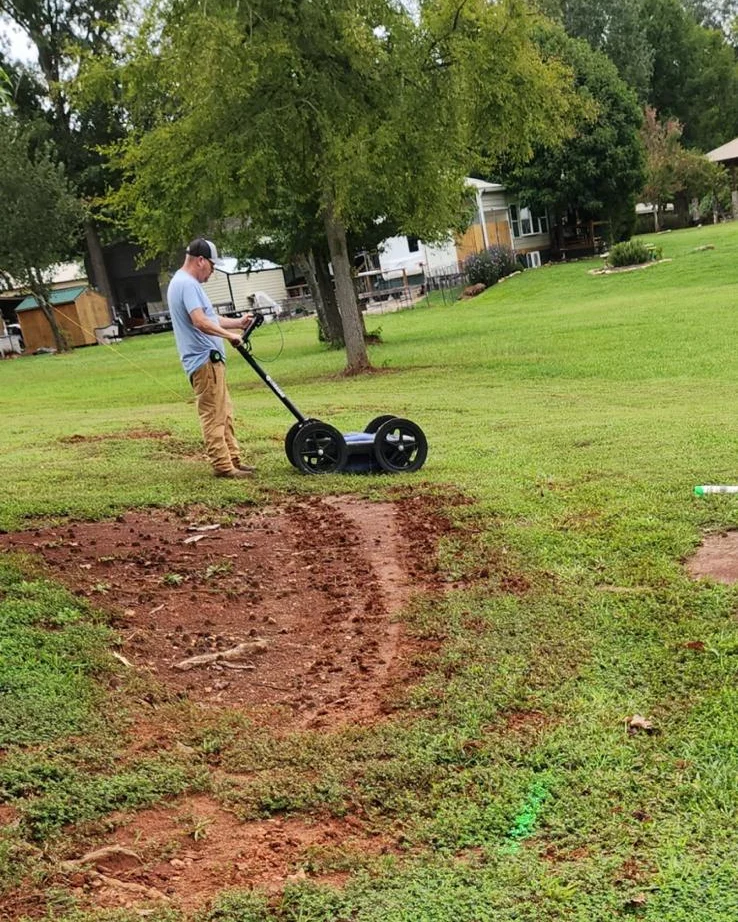
Carolina Septic technician scanning a backyard with a ground penetrating radar cart before digging
On the job: scanning a backyard before anyone digs.

811 marks the street side. The rest of the yard is yours.

Before you dig in South Carolina or Georgia, you call 811 and the utility companies mark their lines. What surprises most homeowners is where that stops. SC811 is plain about it: lines running from the meter to other places on your property are private, and the property owner is responsible for finding them. Georgia 811 says the same and tells homeowners to hire a private locator.

Not marked by 811
  • ×Your septic tank and drainfield
  • ×The sewer line from the house to the tank
  • ×Water lines past the meter
  • ×Power to a detached garage, shop or pool equipment
  • ×Gas to a grill, fire pit or pool heater
  • ×Irrigation lines and low-voltage lighting

Do both. Call 811 for the public lines, then call us for everything they will not mark.

Why Carolina Septic

A septic installer reads the scan

Radar on screen shows shapes, not labels. Telling a drainfield lateral from an irrigation line takes someone who has put both in the ground. That is the job we do every week.

We know what the permit office will ask

If your plans crowd the tank or field, we can tell you what the SC and GA rules mean for your lot, and move the system if it comes to that.

No digging, no damage

The radar rolls across the surface. No probing rods, no test holes, nothing to patch when we leave.

One call on both sides of the river

Tier 3 certified in South Carolina and certified in Georgia. Same crew whichever side of the Savannah your lot sits on.

Where we do it

We work both sides of the Savannah. Licensed in South Carolina and certified in Georgia, which is rarer in this market than it sounds.

Questions people actually ask

What is ground penetrating radar?
Ground penetrating radar, or GPR, is a scanning method that sends short radio pulses into the ground and records the echoes that bounce back off buried objects and changes in the soil. Pipes, tanks and old trenches show up on screen as distinct shapes, which lets us locate them without digging.
Can ground penetrating radar find my septic tank?
Usually, yes. A septic tank is a large target close to the surface, with its top often one to two feet down. Drainfield lines are smaller but show up as a repeating pattern of parallel runs. Where a permit exists, we check it first so the scan confirms the layout instead of starting blind.
Do I need a GPR scan before installing a pool?
No law requires the scan itself, but it is cheap insurance on an expensive job. Pool excavation is one of the most common ways septic systems get destroyed, and a pool that lands on or beside the drainfield can mean relocating the system. Knowing where everything sits before the pool is designed avoids a redesign, a stalled permit or a crushed field.
Does 811 mark my septic system or private lines?
No. 811 marks public utility lines up to the meter or service point. SC811 and Georgia 811 both say private lines past that point are the property owner's responsibility. Septic tanks, drainfields, the sewer line to the tank, water lines to outbuildings, irrigation and power to a detached garage all fall on the owner.
How deep can ground penetrating radar see?
It depends on the soil more than the machine. Dry, sandy soil lets radar read several feet down. Wet clay absorbs the signal and shortens the reach considerably. Septic tanks, drainfield lines and most residential utilities sit within a few feet of the surface, which is the range GPR handles best.
Does GPR work in red clay?
It works, with less depth. Clay, especially wet clay, absorbs radar energy faster than sand. Parts of the CSRA, especially the Sandhills side, sit on sandy soil that scans well. In clay we scan when the ground is drier if the schedule allows, and we tell you plainly where the read was limited.
Will a GPR scan damage my yard?
No. The radar unit rolls across the surface. There is no digging, no probing and no test holes. The only thing left behind is paint and flags marking what we found.
How much does a GPR scan cost?
It depends on the size of the area and what you need found. Locating one tank is a smaller job than mapping a full backyard before a pool build. Call or text (803) 2-PUMP-IT with the address and the project, and we will quote it before we come out.
Do you scan for pool builders and contractors?
Yes. Pool companies, builders and landscapers can book a scan ahead of excavation and have the marks on the ground before their crew arrives. See our builders page for how we fit into a build schedule.
Related services